AREX
- Terminal
- Ticket and platform
- Main rail ride
- Possible transfer
- Exit and final walk
- Hotel entrance
AIRPORT TRANSFER GUIDE
If your route after Seoul Station is simple, compare the AREX Express with the cheaper All-stop Train. For Hongdae, start with the All-stop Train because the Express does not stop at Hongik University. An airport bus can be easier when an official stop is genuinely close to your hotel entrance.
Families, travelers carrying several large bags and people arriving late should also compare an official taxi or a verified pickup. Judge the last usable departure after immigration and baggage claim, not from the scheduled landing time.
My practical rule is to compare the final walk and luggage handling before choosing the fastest-looking option.
CHAPTER 01
Start with the hotel address, your usable departure time and the physical burden of the final kilometer. The transport name comes later.
The right answer depends on the whole trip to the hotel door. First, locate the exact address—not only the neighborhood. Then estimate when you will actually enter the public arrival hall after immigration and baggage claim. Count travelers and large bags, and decide how much transferring, stair use and walking your group can comfortably manage.
I do not start with the vehicle name. I start with the hotel address and the final walk. That habit prevents a fast-looking rail trip from becoming a difficult transfer through a large station.
Compare one or two realistic candidates. Start with AREX for a simple rail connection, the bus for a verified stop near the hotel, or a taxi or pickup when door-to-door simplicity matters more than the lowest fare.
A backup must still operate after your usable departure time and fit everyone with their luggage. Save the official timetable or stop page before flying, especially for a late arrival.
CHAPTER 02
AREX usually wins on predictable rail time, the bus can reduce transfers, and a taxi or pickup reduces handling. None is automatically the easiest door-to-door choice.
The figures below are based on currently published official information. Bus operation and road time vary by route, operator, weather and traffic. Taxi totals vary by destination, meter, traffic, time, vehicle type and possible tolls. Pickup conditions must be checked with the provider.
| Option | Published fare | Main ride | Transfers | Final walk | Luggage handling | Late-night use | Best fit / main limitation |
|---|---|---|---|---|---|---|---|
| AREX Express | Adult ₩13,000; child ₩9,500 | T1–Seoul Station 43 min; T2 51 min | Often one more leg after Seoul Station | Depends on the hotel route | Assigned seat; move bags through the station | Check the dated official timetable | Simple Seoul Station connection / does not stop at Hongik University |
| AREX All-stop | Seoul Station: T1 ₩4,750, T2 ₩5,350; Hongik University: T1 ₩4,650, T2 ₩5,250 with transit card | Seoul Station: T1 59 min, T2 66 min; some trains take 2–6 min longer | Direct to Hongik University; other areas may need another leg | Depends on exit and address | No assigned seats; manage bags in a public train | Check the official timetable | Budget or Hongdae / slower and may be crowded |
| Airport Bus | Representative Seoul routes ₩16,000–18,000 adult; verified major operators list ₩12,000 child | Varies by route, stops, traffic and weather | Usually no rail transfer | Can be short only if the official stop fits the address | Stored luggage; operator rules differ | Route and terminal dependent | Hotel near a verified stop / traffic and final walk |
| Night Bus | Adult ₩17,000–18,000; child ₩10,000–12,000 | Varies by route and traffic | May require a taxi or walk after the stop | Check the exact night stop | Rules vary by operator | Designed for limited overnight windows | Usable route after rail hours / limited routes and departures |
| Regular Taxi | Metered; base ₩4,800 for 1.6 km | Varies by traffic and destination | None after boarding | Usually door-to-door | Confirm trunk capacity before loading | Available from official stands; surcharges may apply | Simple direct trip / total cannot be fixed in advance here |
| Large / Jumbo Taxi | Deluxe, SUV and van base ₩7,000 for 3 km | Varies by traffic and destination | None after boarding | Usually door-to-door | Confirm the exact passenger-and-bag combination | Availability and surcharges vary | Group or bulky luggage / vehicle availability and higher cost |
| Pre-booked Pickup | Provider-specific; compare the complete contract | Varies by traffic and destination | None after meeting the driver | Usually door-to-door | Must match the booked vehicle limit | Depends on meeting and delay policy | Planned assistance / contract, waiting and cancellation conditions |
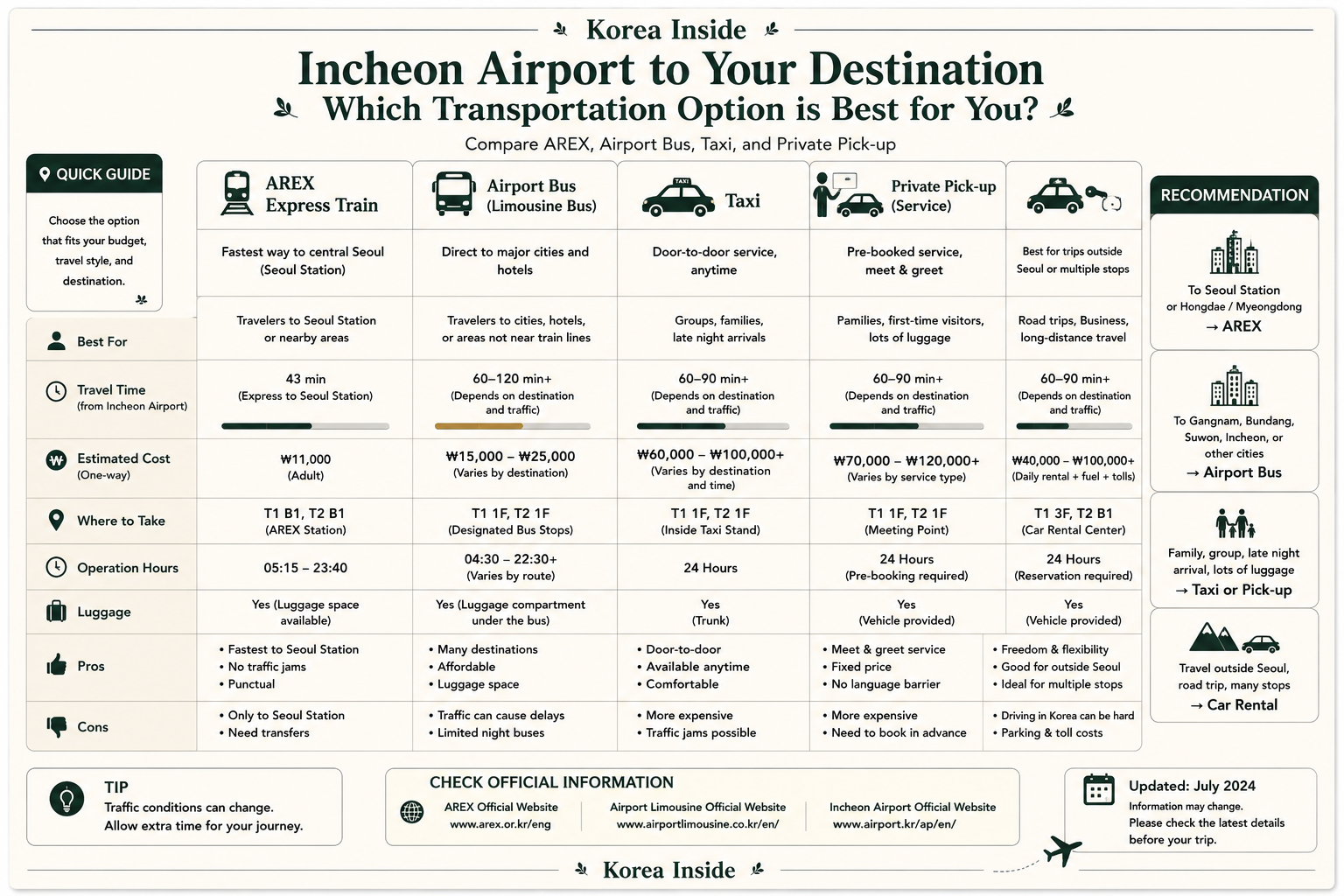
A published rail time ends at a station, not at a hotel. Add the walk to the airport platform, any Seoul transfer, the search for an elevator or suitable exit, and the final street-level walk. A bus may remove a rail transfer but still leave a difficult stop-to-hotel walk. A taxi reduces those steps after boarding.
In my experience, the fastest train is not always the easiest door-to-door option. I compare what happens after Seoul Station before treating 43 minutes as the winning number.
Compare the group total and the hidden effort. Rail or bus fares are normally per person; a taxi or pickup price covers a vehicle but may involve tolls, surcharges or provider-specific extras. Also account for a connecting subway, local taxi, long walk, time spent finding elevators and the possibility that a vehicle cannot accept the passenger-and-luggage combination.
CHAPTER 03
Use traveler type to narrow the comparison, not to make an automatic recommendation. Address, time and luggage can reverse the usual answer.
I have used the AREX, airport buses and taxis on different trips. The most noticeable difference is often how many times the luggage must be lifted and how far the group must walk after the main ride. The first option below is a place to start comparing; the backup is not a universal second choice.
CHAPTER 04
Confirm your terminal before buying or boarding. T1 and T2 use different levels, platforms, bus areas and taxi stand numbers.
Finish immigration and baggage claim, enter the public arrival hall, then confirm both the terminal and chosen mode. Follow airport signs and recheck the live platform or bay. I have repeatedly found that taking one minute to confirm the terminal prevents a much longer correction later.
Bus ticketing is inside Level 1 near exits 4 and 9, with facilities outside near exits 4, 6, 7, 8, 11 and 13. Seoul buses board outside the arrivals level. AREX ticketing and guidance are at Transportation Center B1; trains use B4. Seoul regular taxis use 5C, 6C and 6D; Deluxe/Jumbo use 7C and 8C; International Taxi uses 4C. Night buses use 1F.
Bus ticketing, guidance and boarding are at Transportation Center B1. AREX ticketing and guidance are also at B1; trains use B3. Seoul regular taxis use 7C, Deluxe/Jumbo use 7D and International Taxi uses 3C. Night buses use B1. Follow live airport signs because operating positions can change.
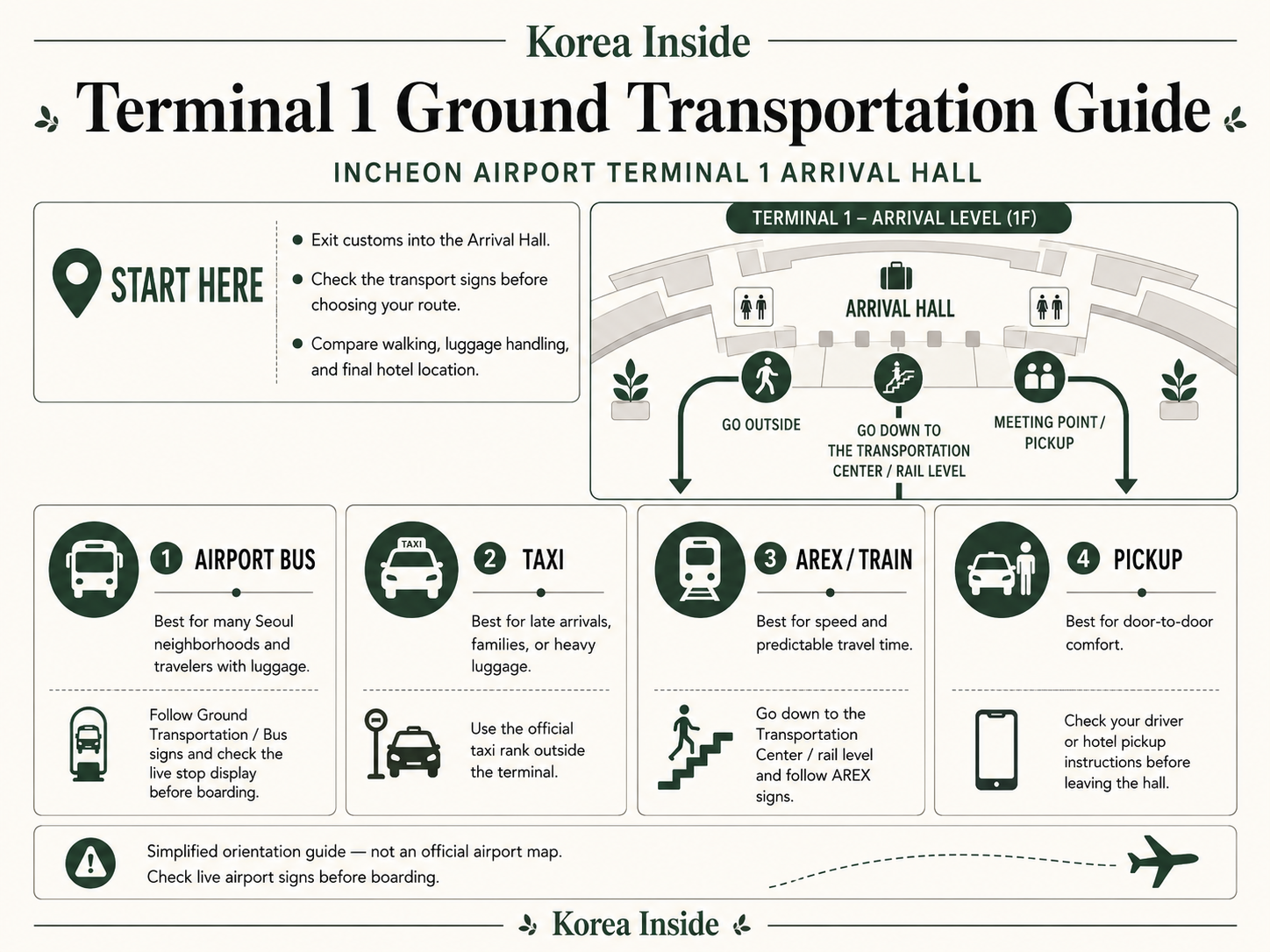
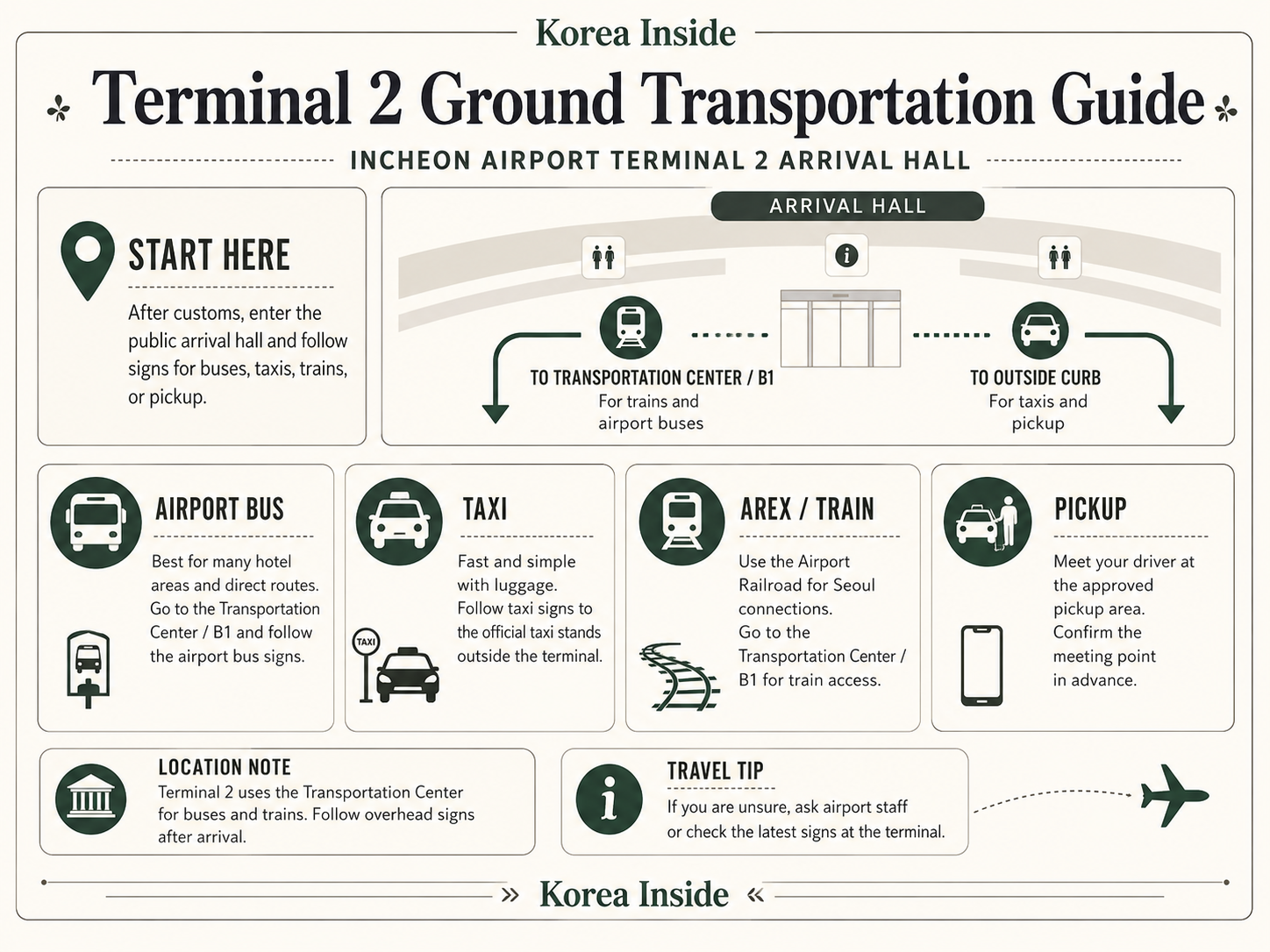
Stop before boarding or paying. Return to an official information point, show the destination and confirm whether the ticket belongs to T1 or T2. Do not improvise from a diagram meant for the other terminal.
Match the terminal, route or train, direction, bay or platform and departure time. Keep the hotel address available in English and Korean when possible.
CHAPTER 05
Choose AREX when the rail ride and the journey after the station are both straightforward. Hongdae and Seoul Station require different train comparisons.
The Express runs to Seoul Station with assigned seats and a separate ticket. Published airport-to-Seoul Station times are 43 minutes from T1 and 51 minutes from T2. The current adult selling fare is ₩13,000 and the child fare is ₩9,500. It does not stop at Hongik University.
The All-stop Train accepts a transit card or single-use card and has no assigned seats. Published times to Seoul Station are 59 minutes from T1 and 66 minutes from T2, with some trains taking 2–6 minutes longer. With a transit card, adult fares are ₩4,750 from T1 and ₩5,350 from T2 to Seoul Station.
Compare Express and All-stop when your hotel is at Seoul Station or the next connection is simple. The Express saves main-ride time and provides an assigned seat; the All-stop costs less. My practical rule is to compare the journey after Seoul Station, not only the train ride. A distant subway platform or unsuitable exit can erase the convenience.
For Hongdae, the All-stop Train is the direct rail comparison. Adult transit-card fares to Hongik University are ₩4,650 from T1 and ₩5,250 from T2. Do not buy the Express expecting it to stop there.
AREX states a basic allowance of no more than two items per passenger, each under 32 kg and with total dimensions under 158 cm. Even compliant bags must be moved through the station and any next connection. Check elevators, exits and the final walk before committing.
I would not choose it merely because the published rail time is short. A tired family, several heavy bags, a difficult transfer or a hotel far from a suitable exit can make a verified bus stop or official vehicle more practical. For detailed tickets and station steps, see the full AREX ticket and station guide. Also review how to buy and use T-money and check the final walk and station exit.
CHAPTER 06
The bus can beat rail when an official stop is truly close to the hotel and removing a station transfer matters more than a predictable travel time.
Search by exact hotel address, then open the official route and stop information. Do not rely on a hotel name or neighborhood label. I usually check the final walk before choosing an airport bus: distance, crossings, hills and whether the route is manageable with luggage.
Ticketing and boarding differ by terminal, route and operator. T1 uses ticket facilities inside and outside the arrivals floor, with buses boarding outside. T2 concentrates bus guidance, ticketing and boarding in Transportation Center B1. Confirm the operator’s current process and the live bay.
Rules are operator-specific. Airport Limousine states up to two items per ticket, each no more than 20 kg and under 160 cm in combined dimensions. K Airport Limousine states up to two items with a combined 40 kg limit. These examples must not be generalized to every route. Ask the operator about oversized items, sports equipment or unusual combinations.
Bus time changes with route, number of stops, traffic and weather. A direct-looking service may still be slower during congestion, while a well-placed stop may save a transfer and a long station walk. Some T2 Seoul-bound services may have operator-specific advance-ticket conditions, so verify the exact route before joining a line.
I would avoid it when the stop is far from the address, the final walk is difficult, the route does not fit the usable departure time or traffic uncertainty creates a serious problem. A stop carrying the hotel’s area name is not proof that it is near the entrance. Find your airport bus route and terminal stop, then check the final walk from the bus stop.
CHAPTER 07
For a late or luggage-heavy arrival, use official transport channels and build a fallback from the time you can actually leave the arrival hall.
Use the marked airport taxi stands and confirm the taxi type before loading. At T1, Seoul regular taxis use 5C, 6C and 6D; Deluxe/Jumbo use 7C and 8C; International Taxi uses 4C. At T2, the corresponding stands are 7C, 7D and 3C. Keep the destination address ready and use the meter or official fare arrangement for the service selected.
A Seoul regular taxi has a ₩4,800 base fare for 1.6 km, then combines distance and time charges. Seoul regular-taxi late-night surcharges are 20% from 22:00–23:00, 40% from 23:00–02:00 and 20% from 02:00–04:00. Deluxe, SUV and van services have a ₩7,000 base fare for 3 km and a 20% late-night surcharge from 22:00–04:00. Tolls may be additional. The airport describes Jumbo taxis as nine-seat vehicles, but confirm the actual passenger-and-luggage fit.
Official published zone fares for Seoul are ₩70,000–95,000 for a sedan and ₩100,000–140,000 for SUV, van or Deluxe service, with tolls potentially separate. Check the destination zone and current conditions. For a broader explanation of vehicle types and payment, understand taxi types and payment.
Current airport information lists N6000, N6002, N6701 and N6703 among overnight options. Adult fares are ₩17,000–18,000 and child fares are ₩10,000–12,000, depending on the service. Routes, terminals and dates have different timetables and stops. A listed night bus does not guarantee that a particular flight’s passengers can complete arrival procedures in time.
After many late arrivals, I would never judge the last train by the scheduled landing time. Immigration, baggage claim and terminal walking can change the real departure time. Use the time you expect to reach the public hall, then leave margin for ticketing and walking to the bay.
A pickup may reduce uncertainty for a family, group, mobility need or arrival outside convenient public-transport hours, but the label “airport pickup” does not define the service. Check vehicle type, passenger and luggage limits, meeting point, free waiting time, flight-delay policy, extra waiting fee, cancellation, no-show terms, car-seat availability and mobility support. Do not assume a provider monitors every delay or waits without limit.
For comparison, the airport’s official Call Van information lists counters between exits 12 and 13 at T1 and near exit 7 at T2, stands 10C and 8D, and operating hours of 08:00–21:00. It describes the target as groups of five or fewer, each with 20 kg of luggage; tolls are separate. Recheck before relying on it.
Do not accept an unverified ride offered by someone approaching you in the terminal. Go to an official counter or stand, or use the documented meeting instructions for a verified booking. If a detail changes, confirm it through the airport or provider rather than following a stranger to an unmarked vehicle.
CHAPTER 08
Choose from the exact address outward, confirm the terminal and live schedule, and save a backup that works with the same people and bags.
For Seoul Station, compare both AREX trains and then inspect the route from the station to the entrance. For Hongdae, begin with the All-stop Train and compare a bus only when its actual stop is better. For Myeongdong, Dongdaemun, Gangnam, Jamsil, Itaewon, Jongno and Insadong, do not decide from the area name alone. Compare the exact bus stop, rail transfer, station exit, stairs or elevator, final walk and a direct vehicle.
In my experience, two hotels described as being in the same area can create very different arrival journeys. One may sit beside a suitable stop; another may require crossings, a hill or a complicated station exit. The address is the decision point.
AREX is the stronger first comparison when the hotel has a simple rail connection, especially around Hongdae or Seoul Station. The bus can be easier when its official stop is close to the hotel entrance and it removes a difficult transfer. Compare the final walk and luggage handling before deciding.
The AREX All-stop Train is usually the lowest published option in this comparison. Adult transit-card fares to Seoul Station are ₩4,750 from T1 and ₩5,350 from T2. A low fare does not include the effort or possible cost of the next connection and final walk.
The AREX Express publishes 43 minutes from T1 and 51 minutes from T2 to Seoul Station. That is the main rail ride, not hotel door-to-door time. Include airport platform access and the route after Seoul Station before treating it as the fastest complete journey.
No. The AREX Express does not stop at Hongik University. For Hongdae, compare the All-stop Train, which runs directly to Hongik University, with a bus or direct vehicle based on the exact hotel address.
You can use a transit card such as T-money on the AREX All-stop Train. The Express requires a separate ticket and assigned seat. Bus ticketing conditions vary by operator and route, so confirm the exact service rather than assuming one payment method works everywhere.
Compare an airport bus, appropriately sized official taxi or verified pickup when repeated lifting and transfers would be difficult. Check operator baggage rules and vehicle capacity. Do not assume a regular taxi can hold your entire passenger-and-suitcase combination.
Check the official AREX timetable first, then the night-bus timetable for your terminal and destination. If neither works after you leave the arrival hall, use an official taxi stand or a verified pickup whose meeting and delay terms you understand.
A regular Seoul taxi starts at ₩4,800 for 1.6 km, while Deluxe, SUV and van services start at ₩7,000 for 3 km. The final amount varies with destination, distance, time, traffic, taxi type, surcharges and possible tolls, so this guide does not state a fixed total.
Use the terminal assigned to your airline and flight, then follow that terminal’s transport signs. T1 and T2 have different train platform levels, bus layouts and taxi stand numbers. Confirm the terminal again before buying a ticket or boarding.
Consider a verified pickup when a family, group, mobility need, several bags or late timing makes other options difficult. Before paying, check the vehicle, capacity, meeting point, free waiting time, delay policy, extra fees, cancellation, no-show, car-seat and mobility-support terms.
Fares, schedules, stands and conditions can change. Use the following official sources to confirm the current information.